PIV Card Enrollment: Complete Guide for Federal Contractors
Master PIV card enrollment with our comprehensive guide covering eligibility, documentation, and common challenges for federal contractors.
March 11, 2026 · Winrove Team
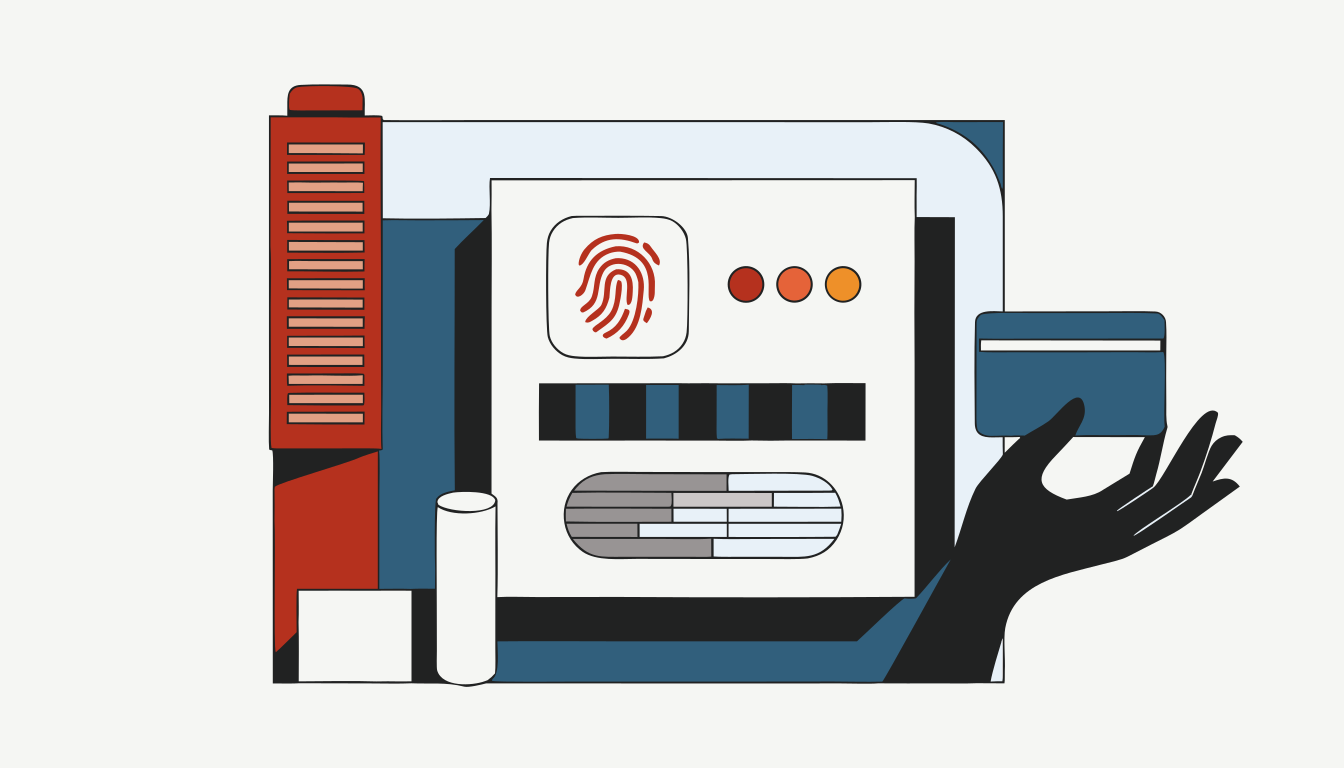
Why PIV Card Enrollment Trips Up Contractors (And How to Get It Right)
A mid-sized IT services firm wins a task order supporting a civilian agency. The project start date is six weeks out. The program manager assumes PIV card enrollment is a formality, schedules appointments two weeks before go-live, and discovers that three of five contractors have name discrepancies between their identity documents and their background investigation records. Two appointments get cancelled. The project kicks off short-staffed, and the agency contracting officer is not pleased. This scenario plays out constantly across the federal contracting community, and it is almost entirely preventable.
Personal Identity Verification (PIV) cards are the primary credential for physical and logical access across the federal government. For contractors, enrollment is not optional if your work requires entry to a federal facility or access to a government network. Understanding the process in detail, including the sequencing, the documentation requirements, and the agency-specific variations, is the difference between a smooth onboarding and a costly delay.
The Governing Standard: FIPS 201 and HSPD-12
PIV cards exist because of Homeland Security Presidential Directive 12 (HSPD-12), issued in 2004, which mandated a government-wide standard for secure and reliable identification of federal employees and contractors. That standard is FIPS 201, published by NIST and updated most recently as FIPS 201-3. The directive applies to all federal agencies and to contractors who require access to federally controlled facilities or information systems.
The PIV card itself is a smart card containing several authentication factors on a single credential: a digital photograph, two fingerprint templates stored on the chip, a PIN, and up to four digital certificates (PIV Authentication, Card Authentication, Digital Signature, and Key Management). This multi-factor architecture is what makes PIV the required credential for logical access under OMB M-11-11 and subsequent policy guidance. A username and password alone does not satisfy federal access requirements for systems covered by these directives.
Eligibility: What Has to Be True Before You Schedule Anything
Enrollment cannot begin until several conditions are satisfied. Rushing to schedule an appointment before these prerequisites are met wastes everyone's time.
Core Eligibility Requirements
- Active contract or agreement: The contractor must have an executed contract, task order, or subcontract that justifies the access need. A pending award is not sufficient.
- Completed background investigation: The type of investigation required depends on the access level. A National Agency Check with Inquiries (NACI) covers most low-risk positions. Positions requiring access to classified systems require a Tier 5 investigation (formerly known as a Single Scope Background Investigation, or SSBI). The investigation must be adjudicated favorably before enrollment proceeds.
- Formal sponsorship: A federal employee with delegated authority, typically a Contracting Officer's Representative (COR), Security Officer, or Facility Security Officer (FSO), must sponsor the contractor and submit the appropriate request through the agency's identity management system (often IDMS or a similar platform).
- Security awareness training: Most agencies require completion of annual security awareness training before issuing credentials. Confirm this requirement with your sponsor before your appointment date.
Eligibility requirements are not uniform across agencies. The Department of Defense uses RAPIDS enrollment stations and ties PIV issuance tightly to the DISS adjudication record. Civilian agencies such as HHS or GSA use their own enrollment workflows. Confirm the specific process with your sponsoring agency's security office before assuming anything.
Required Documentation: Bring Originals, Expect Scrutiny
The documentation standard for PIV enrollment follows the same I-9 identity verification logic: original documents only, no photocopies, no expired credentials. The enrollment officer will inspect each document in person.
Acceptable Document Combinations
- Primary identity document (one required): Valid U.S. passport, passport card, certified copy of a birth certificate issued by a state or county vital records office, or Certificate of Naturalization (Form N-550 or N-570).
- Secondary identity document (one required): Current driver's license or state-issued ID with photograph, military ID card (CAC), or Permanent Resident Card if applicable.
- Social Security verification (one required): Social Security card (not laminated), W-2 form, or pay stub showing the full SSN. Some agencies accept a Social Security Administration benefit letter.
- Sponsorship documentation: The agency-generated sponsor authorization form, often printed from the IDMS or emailed directly to the enrollment center. Verify the format your agency uses.
Name consistency across all documents is critical. If your driver's license shows a maiden name and your background investigation was conducted under a married name, you need legal documentation of the name change (a certified marriage certificate or court order) to reconcile the discrepancy. This is the single most common reason appointments fail on the first attempt.
The Enrollment Appointment: Step by Step
Enrollment appointments are conducted at designated Identity Management facilities, often located within federal buildings or at authorized enrollment centers operated by contractors such as Leidos or IDEMIA under government contracts. Appointments typically run 30 to 60 minutes, though first-time enrollments with complications can run longer.
What Happens During the Appointment
- Document review: The enrollment officer verifies each document for authenticity, expiration, and consistency. This step cannot be skipped or abbreviated. Arrive early.
- Biometric collection: All ten fingerprints are captured using a live-scan device. A digital photograph is taken against a plain background under controlled lighting. Some agencies also collect iris scans for higher-assurance access. If fingerprint quality is poor due to worn ridges, skin conditions, or injury, the technician will attempt recapture. Persistent quality failures may require a waiver process and alternative documentation.
- PIN establishment: The contractor selects a PIN that will be required for logical access authentication. This PIN is never stored by the agency; if forgotten, the card must be reset or reissued.
- Certificate generation: The enrollment system generates cryptographic key pairs and submits certificate signing requests to the agency's Certificate Authority (CA). This process typically takes two to five minutes and happens automatically.
- Card personalization and issuance: The card is printed, encoded, and verified. Most enrollment centers issue the card on the spot. Some agencies, particularly those using centralized card production facilities, mail the card within five to ten business days.
Common Failure Points and How to Avoid Them
Sponsorship Gaps
If the sponsoring federal employee has not completed their side of the workflow in the agency IDMS before the contractor's appointment, the enrollment officer cannot proceed. Confirm with your sponsor at least 48 hours before the appointment that their authorization is fully submitted and visible in the system.
Background Investigation Status
An investigation that is initiated but not yet adjudicated will block enrollment. Check your status through your FSO or the agency security office before scheduling. Do not assume that because you passed a previous investigation for a different agency, the current sponsoring agency will accept it. Reciprocal acceptance of investigations is policy under Security Executive Agent Directive 7 (SEAD 7), but individual agencies do not always implement it consistently.
Biometric Exceptions
Contractors with documented medical conditions affecting fingerprint quality should contact the enrollment center before the appointment. Agencies have established exception procedures under FIPS 201-3, but those procedures require advance coordination and additional documentation. Showing up and hoping for the best is not a strategy.
After Enrollment: Ongoing Credential Management
PIV card validity periods are typically three years, though some agencies issue cards for shorter periods tied to contract duration. Renewal requires a new enrollment appointment and updated background investigation if the existing investigation has lapsed beyond the reinvestigation cycle.
Lost or stolen cards must be reported immediately to the issuing agency's security office. Most agencies can deactivate a card within hours of a report, but the contractor loses access until a replacement is issued. Keep a record of your card's serial number and the agency security office contact information separate from the card itself.
Name changes, changes in clearance level, or changes in contract scope that affect access requirements all require coordination with the sponsoring agency. In some cases, a new card must be issued to reflect updated information. Do not wait for the card to expire to address these changes.
Practical Takeaway
Start the PIV enrollment process at least six to eight weeks before your project access date. Confirm sponsorship is active in the agency system, verify that your background investigation is adjudicated, and audit every identity document for name consistency before scheduling. For contractors managing multiple personnel across multiple agencies, a simple tracking spreadsheet with enrollment status, investigation adjudication date, and card expiration date will prevent the last-minute scrambles that derail project starts. Tools like Winrove, built by IT Custom Solution LLC specifically for federal contractor onboarding workflows, can centralize this tracking and flag expiration and renewal deadlines before they become access problems.
Preserved Field Notes article. Original path /blog/piv-card-enrollment-complete-guide-federal-contractors/. No unrelated help guide has been substituted.
Related Field notes
Cleared Employee Onboarding: Essential Guide for Government Contractors ↗
DCSA Clearance Process: Complete Guide for Contractors ↗
DoD Contractor Hiring: Essential Guide for Defense Recruitment ↗
Mastering the Interim Clearance Onboarding Process for Security ↗
Mastering the SF-86 Form: A Comprehensive Guide for Security Clearance ↗