Federal Market Research: Finding the Agencies That Buy What You Sell
Before you write a single proposal section, you need to know which agencies actually buy your NAICS codes. Here is how to find them.
August 17, 2026 · Winrove Team
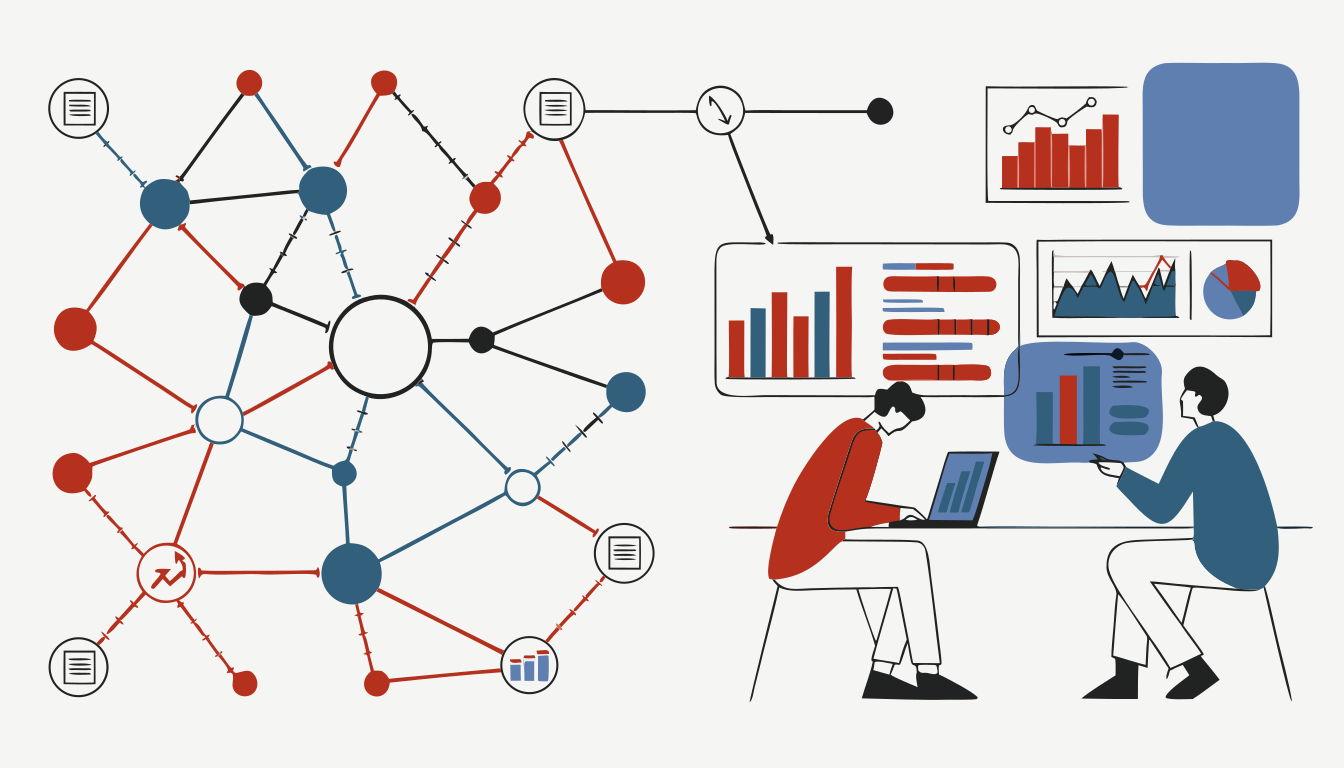
The Question Every Capture Manager Faces First
You have a NAICS code, a capability statement, and a SAM.gov registration. The next question is not "how do I write a winning proposal?" It is "who actually buys this?" Skipping that question and chasing every solicitation that looks adjacent to your work is how proposal teams burn capacity on pursuits they were never positioned to win.
Federal market research is the discipline that answers the buyer question before you commit resources. Done well, it tells you which agencies have a recurring need for your services, what vehicles they use to buy, what they have paid in the past, and whether small business set-asides are a realistic path in. Done poorly, it produces a list of agency names with no actionable intelligence behind them.
This post walks through a concrete, repeatable research sequence you can run before a solicitation even drops.
Start With NAICS, Not Agency Names
A common mistake is to start with an agency you admire, then work backward to find opportunities. The more reliable sequence runs the other direction: start with the NAICS codes that accurately describe your work, then find the agencies that obligate dollars under those codes.
SAM.gov's Contract Opportunities search and USASpending.gov both allow filtering by NAICS. On USASpending.gov, navigate to the Advanced Search under Awards, filter by NAICS code, set a date range covering the last two to three fiscal years, and sort by awarding agency. What you get is a ranked list of agencies by obligation volume under your code. That list is your initial target set, grounded in actual spending behavior rather than assumption.
If your work spans multiple NAICS codes, run the search for each one. Federal buyers do not always assign the same code to conceptually similar work, so a services firm doing IT program management might see relevant awards under 541511, 541512, 541519, and 541611 depending on how the contracting officer categorized the requirement.
Read the Award Data, Not Just the Dollar Totals
Once you have a list of awarding agencies and dollar volumes, go one level deeper. For each agency on your short list, look at the individual award records. Several data points matter for positioning:
- Set-aside type: Was the award a small business set-aside, an 8(a) sole source, a full and open competition, or an IDIQ task order? If an agency consistently awards your NAICS code as unrestricted, your path in as a small business is harder unless you can team or qualify for a specific vehicle.
- Contract vehicle: Was the award made through a GSA Schedule, a GWAC like CIO-SP3 or Alliant 2, an agency-specific IDIQ, or an open-market procurement? If the agency buys primarily through a vehicle you do not hold, that is a gap to address before pursuing task orders.
- Incumbent: Who holds the current contract? How large is that firm? A small business incumbent is a signal that the agency is comfortable with small business performance at that scope. A large prime incumbent on a long-running cost-plus contract signals a different competitive environment entirely.
- Period of performance: When does the current contract expire? Awards with base periods ending within 12 to 18 months are candidates for recompete tracking. USASpending.gov shows the potential end date on most award records.
Cross-Reference With FPDS and Agency Forecasts
USASpending.gov pulls from the Federal Procurement Data System (FPDS), but FPDS itself offers additional filtering granularity, particularly for product and service codes (PSCs) that sit alongside NAICS codes in the award record. If your NAICS search returns noisy results, layering in a PSC filter can sharpen the picture.
Many agencies also publish annual procurement forecasts, sometimes called acquisition forecasts or opportunity forecasts, on their acquisition or small business office pages. The Department of Homeland Security, the Department of Veterans Affairs, and several civilian agencies post these lists, which identify anticipated procurements by NAICS code, estimated value, set-aside type, and expected solicitation timeframe. These forecasts are not binding, and timelines shift, but they are a direct signal of agency intent that complements the historical spending data.
The Small Business Administration's SUB-Net database and agency Office of Small and Disadvantaged Business Utilization (OSDBU) pages are additional sources. OSDBU offices exist specifically to connect small businesses with agency buyers. Attending an OSDBU matchmaking event or scheduling a capability briefing is a legitimate, low-cost way to get your name in front of a contracting officer before a requirement is formally on the street.
Qualify the Agencies on Your List
Not every agency that has spent money in your NAICS code is worth pursuing. Apply a short qualification filter before you invest further:
- Volume threshold: Is the agency obligating enough in your NAICS code to support a realistic pipeline? A single small award three years ago is not a pattern.
- Small business utilization rate: USASpending.gov and agency scorecards published under the Small Business Act show what percentage of eligible dollars went to small businesses. Agencies with strong small business utilization rates are more likely to structure future requirements as set-asides.
- Geographic and clearance fit: Some agency requirements are tied to specific locations or clearance levels. If your team is not positioned for those constraints, factor that into the go/no-go calculus early.
- Relationship starting point: Do you have any existing past performance with this agency, a teaming partner who does, or a point of contact in the program office? Cold pursuits are harder. Agencies that already know your work, or know a firm you can team with, are higher-probability targets.
Map Vehicles Before You Chase Solicitations
Federal agencies increasingly buy through contract vehicles rather than open-market procurements. If your target agencies buy primarily through a GWAC or agency IDIQ that you do not hold, you have two options: pursue a teaming arrangement with a firm that holds the vehicle, or invest in qualifying for the vehicle itself at the next on-ramp opportunity.
Understanding which vehicles an agency uses is part of market research, not an afterthought. Check the award records for vehicle identifiers. GSA Schedule orders will show a Schedule contract number. GWAC orders will reference the vehicle name in the contracting office data. If a pattern emerges, for example, an agency consistently buying your NAICS code through CIO-SP3, that tells you where to focus vehicle strategy.
Organize What You Find
Market research produces a lot of raw data. The output that actually drives capture decisions is a structured target agency list with, at minimum, the following fields for each entry: agency name, sub-component (bureau or office), NAICS codes relevant to your work, annual obligation volume, primary vehicle, small business set-aside percentage, nearest recompete date, and current incumbent. That document becomes the foundation for your pipeline and your BD outreach calendar.
When a solicitation does drop from an agency on your list, you are not starting from zero. You already know the buyer's spending patterns, the incumbent's identity, and the vehicle structure. That context shapes how you read the RFP, what questions you ask at the pre-proposal conference, and how you frame your differentiators.
Capture teams that treat market research as a one-time activity before a specific solicitation are always catching up. The ones that maintain a living agency target list, updated quarterly against USASpending data and agency forecasts, are positioned to respond faster and with more specificity when a solicitation does appear.
When you are ready to move from agency research into solicitation analysis, tools like Winrove can help you work through a specific RFP, surface requirement gaps in a draft response, and organize past performance against the evaluation criteria. Winrove is a product of IT Custom Solution LLC.
The Short Takeaway
Federal market research is not a search for opportunities. It is a search for buyers. Run your NAICS codes through USASpending.gov, read the award records for set-aside type and vehicle, cross-reference agency forecasts, and qualify your target list against volume, small business utilization, and relationship starting points. Do that work before a solicitation drops and you will spend your proposal resources on pursuits where you were already positioned to compete.
Want help thinking through your agency targeting approach or how to structure a capture-ready solicitation review? The team at IT Custom Solution is available for a brief consult. Reach out through the contact page and describe what you are working on.
Related Field notes
How to Respond to a Sources Sought Notice and Shape the RFP Before It Drops ↗
SBIR and STTR Basics for Technology-Focused Small Firms ↗
GWAC and IDIQ On-Ramps: How Small Businesses Get onto a Contract Vehicle ↗
Federal Contract Types Explained: FFP, T&M, and Cost-Reimbursement ↗
Joint Ventures and the SBA Mentor-Protege Program: A Practical Guide for Small Contractors ↗
Building a 12-Month Pipeline from Agency Procurement Forecasts ↗