Security Clearance Processing: A Complete Guide for Employers
Managing security clearances is one of the most complex aspects of government contractor HR. This guide covers every stage from initiation to adjudication.
March 7, 2026 · Winrove Team
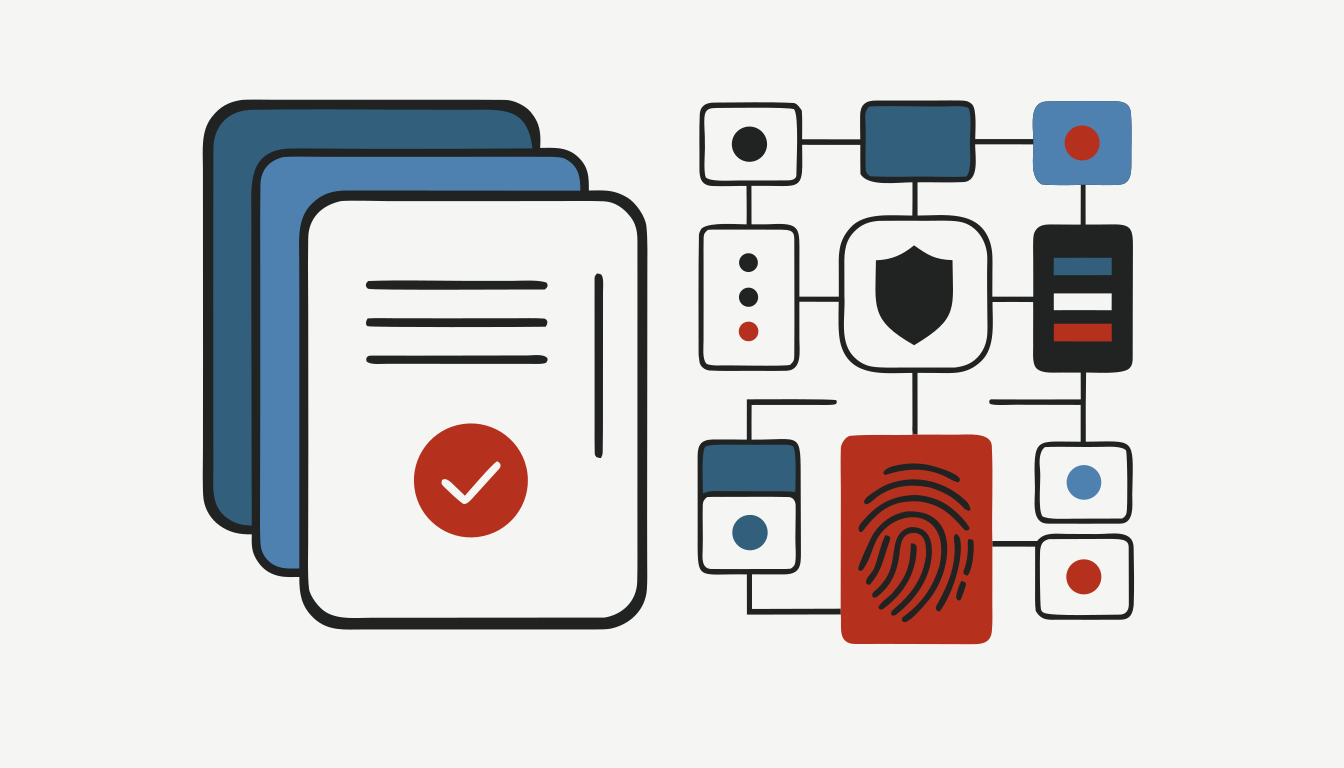
Understanding the Clearance Ecosystem
For government contractors, security clearances are both a business requirement and an operational bottleneck. You can't staff a classified program without cleared personnel, but obtaining and maintaining clearances involves navigating a complex system with multiple federal agencies, unpredictable timelines, and significant administrative overhead.
This guide is written for HR managers, program managers, and operations leaders at government contracting firms who need to manage clearances at scale: not just for one employee, but across an entire workforce.
Types of Clearances and What They Cover
Public Trust Positions
Not technically a clearance, but a federal suitability determination required for many civilian agency contracts. Public Trust positions are designated Low Risk, Moderate Risk, or High Risk based on the sensitivity of the work. The investigation involved (typically an MBI or NACLC) is less extensive than clearance investigations but can still take weeks to complete.
Confidential
The baseline personnel security clearance level. Required for access to information that could cause "damage" to national security if disclosed. Investigated with a Tier 3 investigation (National Agency Check with Law and Credit). Relatively rare in the modern clearance landscape as most programs have moved to Secret or above.
Secret
The most common clearance in government contracting. Required for information whose disclosure could cause "serious damage" to national security. Involves a Tier 3 investigation (same as Confidential for initial grants). As of 2024, Secret clearances are being processed by DCSA (Defense Counterintelligence and Security Agency), and timelines have improved significantly: many initial Secret clearances are processed in 3-6 months.
Top Secret (TS)
Required for access to information whose disclosure could cause "exceptionally grave damage." Involves a Tier 5 investigation, which is significantly more thorough than Tier 3. Expect 6-18 months for initial TS clearances, though DCSA has been making progress on reducing backlogs.
Top Secret/SCI
TS clearance plus Sensitive Compartmented Information access. SCI access is granted by the relevant intelligence agency (DIA, CIA, NSA, etc.) after the TS is granted. Polygraph examinations may be required depending on the agency and program. Total timeline can stretch to 24+ months.
The Employer's Role in the Clearance Process
Many employers underestimate how active their role is in the clearance process. Here's what employers must do:
Step 1: Verify Eligibility and Sponsorship Authority
Only organizations with a valid facility clearance (FCL) can sponsor individuals for personnel security clearances. If your company doesn't have an FCL, you need to obtain one through DCSA before sponsoring employees. The FCL process involves your company passing its own security review, which can take several months.
Confirm with your Facility Security Officer (FSO) that your FCL is active and at the appropriate level before initiating any new clearance requests.
Step 2: Initiate the Investigation Request
Clearance requests are submitted through the National Industrial Security System (NISS) or Joint Personnel Adjudication System (JPAS). Your FSO manages this. When initiating:
- Confirm the exact clearance level required for the position (check the DD-254)
- Verify the position is coded for the appropriate investigation type
- Ensure the request specifies the correct subject demographics
Step 3: Support the SF-86 Completion
The Standard Form 86 (SF-86) is the foundation of almost all personnel security clearance investigations. For higher-level clearances, it's now completed as an electronic questionnaire (eQIP). The SF-86 is extensive: it covers the last 10 years of employment, residences, foreign contacts, travel, finances, and personal conduct.
Your role as employer is to ensure your new hire understands:
- Completeness beats brevity: incomplete SF-86s are returned and cause delays. When in doubt, disclose.
- Honesty is non-negotiable: falsification is worse than the underlying issue in virtually every case
- Previous employers and references should be heads-up'd: investigators contact them, and a surprised reference reflects poorly
- Financial issues need context: brief explanations of past financial difficulties, if provided proactively, are viewed more favorably
Step 4: Facilitate the Investigation
During the investigation, DCSA investigators may contact your company for employment verification and character information. Designate a point of contact for investigation inquiries and ensure that person responds promptly. Delayed employer responses are a significant source of clearance processing delays.
Managing Clearance Timelines
Current DCSA processing timelines (as of 2025):
- Secret initial: 75-120 days for most cases
- TS initial: 150-300+ days
- TS/SCI initial: 300-600+ days (varies widely by agency)
- Interim clearances: Available in some cases within 30-60 days while full investigation proceeds
These are averages. Complex cases (extensive foreign travel, financial issues, prior drug use) take significantly longer. Build clearance timeline uncertainty into your contract staffing models.
Clearance Maintenance: The Ongoing Employer Obligation
Granting a clearance is the beginning, not the end. Employers have continuous obligations:
Periodic Reinvestigations
- Secret: Every 10 years
- Top Secret: Every 6 years (continuous evaluation for most TS holders since 2018)
- TS/SCI: Every 5 years, often with polygraph requirements
Continuous Evaluation (CE)
Most cleared personnel are now enrolled in Continuous Evaluation, which uses automated record checks to identify potential security concerns between formal reinvestigations. CE can flag financial changes (new debts, bankruptcy), criminal record updates, and other triggers requiring FSO review.
Reportable Information
Employees and employers are required to report certain events to the FSO promptly:
- Arrests, charges, or convictions
- Financial problems (bankruptcy, significant new debt, wage garnishment)
- Foreign contacts or travel (especially to sensitive countries)
- Mental health hospitalizations or treatment (context and nature matter significantly)
- Adverse employment actions related to workplace conduct
Failure to report is itself a security concern that can jeopardize a clearance.
Building an Effective Clearance Management System
For contractors managing 50+ cleared employees, manual clearance tracking becomes untenable. You need systems that:
- Maintain current clearance status for every employee
- Alert ahead of reinvestigation deadlines (at 18 months and 6 months out)
- Track polygraph expiration dates by agency/program
- Log reportable events and FSO notifications
- Generate reports for contract compliance and business development
The cost of a lapsed clearance: losing a cleared employee from a contract and scrambling to replace them: far exceeds the cost of proper clearance management infrastructure.
Preserved Field Notes article. Original path /blog/security-clearance-processing-complete-guide-employers/. No unrelated help guide has been substituted.
Related Field notes
Cleared Employee Onboarding: Essential Guide for Government Contractors ↗
DCSA Clearance Process: Complete Guide for Contractors ↗
DoD Contractor Hiring: Essential Guide for Defense Recruitment ↗
Mastering the Interim Clearance Onboarding Process for Security ↗
Mastering the SF-86 Form: A Comprehensive Guide for Security Clearance ↗
PIV Card Enrollment: Complete Guide for Federal Contractors ↗