From Offer Letter to Badge: Mapping the Federal Onboarding Chain
Federal contractor onboarding spans six to twelve weeks and touches a dozen compliance checkpoints. Here is how to map every handoff before it breaks.
June 26, 2026 · Winrove Team
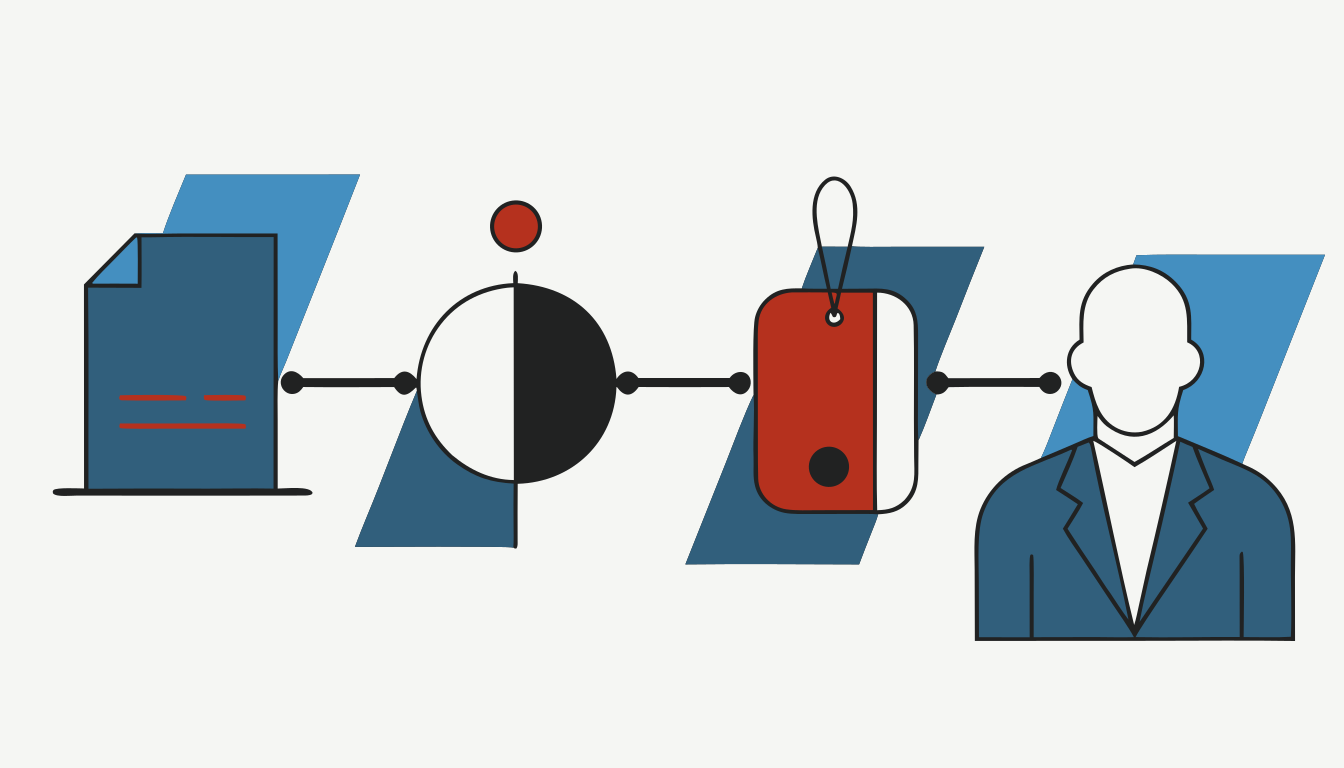
A cleared contractor accepted an offer on a Monday. By Friday, the program office was asking when she could badge in. The answer, it turned out, was eleven weeks later, because nobody had sequenced the I-9, the facility access request, and the SF-86 initiation in the right order. The offer letter went out before the contract mod was signed, the E-Verify case sat open past the three-business-day window, and the security officer did not receive the investigation package until week four. Every one of those delays was preventable. Every one of them came from treating onboarding as a series of independent tasks rather than a chain with hard dependencies.
Why Federal Onboarding Is Not a Single Process
Commercial onboarding is largely an HR function. Federal contractor onboarding is a compliance relay race with at least four distinct lanes: HR and employment law, security and investigations, facility and systems access, and program or contract administration. Each lane has its own governing authority, its own paperwork, and its own clock. The I-9 clock starts on day one of employment. The E-Verify case must open within three business days of hire. The SF-86 submission timeline is set by the Cognizant Security Agency. The PIV or facility badge issuance follows HSPD-12 and the specific agency's Physical Security office schedule. None of these clocks are synchronized by default. Your job as the onboarding lead is to synchronize them.
Stage One: Pre-Offer and Contract Alignment
The chain starts before the offer letter is signed. Two questions must be answered first: Is there a funded contract line item for this position, and does the position require a security clearance or public trust determination? Sending an offer without a signed contract mod or task order in place creates a downstream problem where the candidate completes I-9 and E-Verify, accepts the role, and then waits while contracting catches up. That is not a theoretical risk. It happens routinely on IDIQ vehicles where task orders lag behind program office hiring decisions.
If the position requires a clearance, the offer letter itself needs careful language. You cannot condition employment on the candidate already holding the required clearance level in most cases, but you can make the offer contingent on the candidate's ability to obtain and maintain the required clearance. That distinction matters legally and operationally. Get your offer letter template reviewed against the specific contract's security requirements before it goes out.
Stage Two: I-9 and E-Verify
Section 1 of Form I-9 must be completed by the employee no later than the first day of employment. Section 2 must be completed by the employer within three business days. For remote hires, which now represent a significant share of federal contractor onboarding, the employer must use an authorized representative to physically examine documents unless the employer qualifies under DHS's alternative procedure for E-Verify participants. As of mid-2023, E-Verify employers may use a remote examination procedure with specific retention and fraud-prevention requirements. If your firm is enrolled in E-Verify, confirm which procedure your process follows and document it.
E-Verify cases must be created within three business days of the hire date, not the offer date, not the start date of the contract. A Tentative Nonconfirmation (TNC) requires specific written notice to the employee and a defined resolution window. Do not close a TNC case prematurely, and do not take adverse action during the contest period. These are statutory requirements under IRCA, not suggestions.
Stage Three: Security Clearance Initiation
If the position requires a clearance, the SF-86 (Standard Form 86, Questionnaire for National Security Positions) must be initiated through the appropriate system, currently DISS (Defense Information System for Security) for DoD contractors, or the relevant agency system for civilian agencies. The FSO (Facility Security Officer) owns this lane. The FSO must verify that the facility has an active FCL (Facility Clearance) at the appropriate level before sponsoring an individual investigation.
Common sequencing failures here include: initiating the SF-86 before the candidate has completed I-9 (creating a records mismatch), submitting an incomplete SF-86 that bounces back from the adjudicator, and failing to coordinate the interim clearance request with the program office so that work can begin under interim access while the full investigation runs. Interim access is not guaranteed, but for many programs it is the only way to get a contractor productive within a reasonable timeframe. The FSO should be looped in at the offer stage, not after the candidate's start date.
Stage Four: HSPD-12 and Physical/Logical Access
For contractors working on-site at federal facilities, HSPD-12 governs the issuance of the PIV (Personal Identity Verification) card. PIV enrollment requires identity proofing, biometric capture, and adjudication of the background investigation. The agency's ICAM (Identity, Credential, and Access Management) office runs this process, and it operates on its own schedule, which is frequently the longest single wait in the chain.
Logical access, meaning network accounts, VPN credentials, and system-specific access, is often gated behind PIV issuance or behind a separate IT provisioning workflow. Program offices frequently underestimate this lag. A contractor who badges in on day one may still be waiting two weeks for a network account. Map both the physical and logical access workflows explicitly, identify who submits the access request and when, and build the submission into your onboarding checklist at stage two or three, not stage four.
Stage Five: Electronic Signature and Agreement Execution
Contractor agreements, NDAs, acceptable use policies, and system access agreements are typically executed via electronic signature. ESIGN and UETA provide the federal and state legal framework for electronic signatures on these documents. For federal systems access agreements (e.g., Rules of Behavior under FISMA), confirm that the agency accepts electronic execution and retains a compliant audit trail. Some agencies still require wet signatures on specific forms. Know which documents fall into which category before your onboarding workflow assumes everything can be e-signed.
Building the Dependency Map
The practical tool here is a simple dependency matrix, not a Gantt chart with optimistic durations, but a map that shows which steps cannot start until which prior steps are complete. For most federal contractor onboarding chains, the critical path looks like this:
- Contract mod or task order confirmed (prerequisite for offer)
- Offer letter executed (prerequisite for I-9 and E-Verify initiation)
- I-9 Section 2 completed and E-Verify case opened (prerequisite for SF-86 submission in most FSO workflows)
- SF-86 submitted and investigation initiated (prerequisite for interim access request)
- Interim or final clearance granted (prerequisite for PIV enrollment request at many agencies)
- PIV issued (prerequisite for physical badge and often logical access)
- IT provisioning request submitted (can often run parallel to PIV; confirm with agency)
- System access agreements executed (prerequisite for network account activation)
Every handoff in that list is a potential stall point. Assign an owner to each handoff, set a trigger date for each submission, and build a status check cadence into your program management rhythm. Weekly is not too frequent for a chain with this many dependencies.
Takeaway
Federal contractor onboarding fails at the handoffs, not the tasks. Document every dependency, assign every handoff an owner, and start the security and access lanes as early as the contract and offer allow. A written onboarding chain map, even a one-page table, will surface sequencing errors before they cost you weeks. For teams managing multiple programs or high-volume hiring, a purpose-built onboarding platform like Winrove, developed by IT Custom Solution LLC, can enforce the sequence and flag stalled steps automatically.
If you want to talk through how to structure your onboarding chain for a specific program or contract type, reach out to our team for a brief working session. No pitch, just a practical conversation about your workflow.
Preserved Field Notes article. Original path /blog/from-offer-letter-to-badge-mapping-the-federal-onboarding-chain/. No unrelated help guide has been substituted.
Related Field notes
1099 vs W-2 Onboarding Flows for GovCon Staffing: What Changes and Why It Matters ↗
5 Steps to Onboard Government Contractors Faster in 2026 ↗
Building Onboarding Templates: A Complete Guide for 2024 ↗
Comprehensive DoD Onboarding Checklist for clean Integration ↗
Conditional Offers Pending Clearance: Managing the Waiting Gap ↗
Day-1 Readiness Checklists for Federal Contract Staff: What Has to Be Done Before the Badge Swipe ↗