1099 vs W-2 flows in onboarding
The classification audit finding and the workflow that prevents it.
May 24, 2026 · Winrove Team
The Classification Problem Starts at the Onboarding Screen
A Department of Labor worker-classification audit in 2023 flagged a mid-sized federal IT contractor for exactly this: seventeen independent contractors had completed W-4 withholding elections, eleven had active E-Verify cases, and four had I-9 records on file. None of them were employees. The HRIS had presented every new record with the same intake form, the contractors filled it out because the system asked, and the resulting data looked indistinguishable from an employee record. The company owed back payroll taxes, faced potential penalties under IRC Section 3509, and spent four months reconstructing which records were legitimate and which were artifacts of a broken onboarding flow.
That scenario is not unusual. The leading audit finding in a DOL worker-classification review is not that a company made a deliberate misclassification decision. It is that the onboarding system treated a 1099 engagement like a W-2 hire and generated the wrong paper trail automatically. The fix is not better form UX. The fix is a different form, triggered by a different branch, producing a different downstream packet from the first screen.
Why Generic HRIS Flows Create Classification Risk
Most HRIS platforms are designed around the employee lifecycle. Their onboarding modules assume a W-2 relationship: collect personal data, generate a W-4, open an I-9, trigger E-Verify, route to payroll. When a company uses that same flow for independent contractors, several things go wrong simultaneously.
- Wrong tax forms collected. A W-4 is an employee withholding certificate. Collecting it from a 1099 contractor implies the company is treating them as an employee for withholding purposes, which is evidence of misclassification under IRS common-law factors.
- I-9 and E-Verify cases opened incorrectly. Form I-9 is required for employees under the Immigration Reform and Control Act. Running I-9 and E-Verify on an independent contractor is not legally required and, more importantly, creates a record that looks like an employment record to an auditor.
- Missing contractor-specific documents. A 1099 engagement requires a W-9 (for backup withholding), a written services agreement, an IP assignment or work-for-hire clause, and often a certificate of insurance. Generic HRIS flows do not collect any of these.
- No scope or deliverable documentation. One of the IRS's behavioral-control factors is whether the company controls how work is done versus only the result. A documented scope of work with deliverables supports independent-contractor status. An onboarding flow that skips this leaves the relationship undocumented.
The result is a file that contains employee evidence and no contractor evidence. When a DOL or IRS examiner pulls that file, the classification defense starts from a deficit.
The Correct Architecture: Separate Branches, Separate Packets
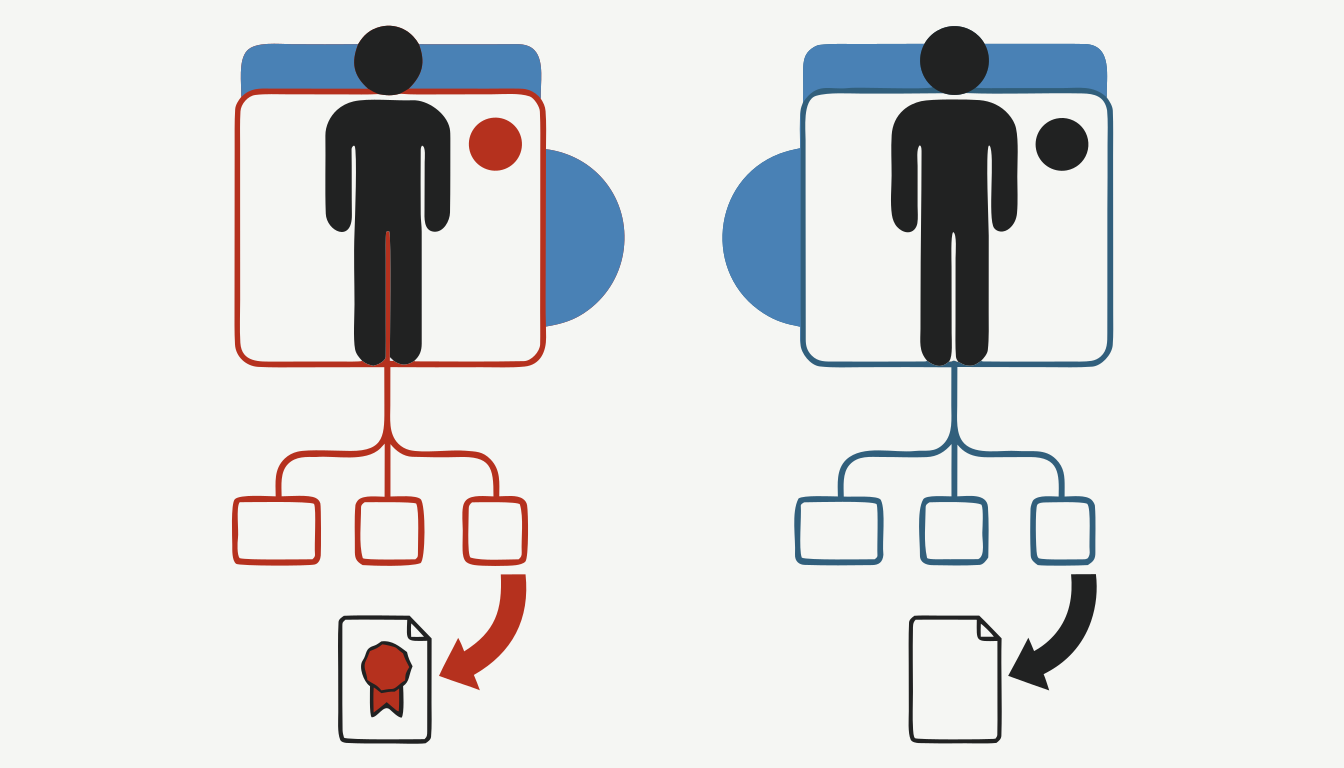
The right approach is to branch the onboarding flow at the classification decision and produce entirely different document packets downstream. Winrove, a product of IT Custom Solution LLC available at winrove.com, ships three distinct branches: W-2 employee, 1099 independent contractor, and subcontractor-of-prime. Each branch collects only the forms appropriate to that relationship and explicitly does not collect the forms that belong to the other relationships.
W-2 Employee Branch
The W-2 branch follows the standard employment onboarding sequence. It collects a W-4, opens an I-9 with document verification, triggers an E-Verify case, routes to payroll enrollment, and captures benefits elections. For federal contractors, it also handles position-specific requirements: security clearance acknowledgments, HSPD-12 PIV enrollment initiation, and any contract-specific certifications. The packet produced is an employment record, and it looks like one because it is one.
1099 Independent Contractor Branch
The 1099 branch produces a completely different packet. It collects a W-9 (name, TIN, backup withholding certification), a signed services agreement with a defined scope of work and deliverable schedule, an IP assignment or work-for-hire clause appropriate to the engagement, and a certificate of insurance confirmation where the contract requires it. It does not produce a W-4, does not open an I-9, and does not trigger an E-Verify case. The absence of those records is intentional and documented: the system records that the branch was evaluated and that the employee forms were affirmatively not generated.
That negative record matters. If an auditor later asks why there is no I-9 on file for a contractor, the answer is not "we forgot." The answer is "the onboarding system evaluated the relationship as a 1099 engagement at intake and did not generate an I-9 because none was required." That is a defensible position. "We use the same system for everyone and this one slipped through" is not.
Subcontractor-of-Prime Branch
Federal contracting adds a third category that most onboarding tools ignore entirely: the subcontractor of a prime. In this relationship, the prime contractor has already run compliance on the individual or entity. The sub does not need to rerun the prime's flow. What the prime needs is evidence that the sub's compliance was completed and that the pass-through is documented.
The subcontractor branch in Winrove captures that pass-through evidence: the prime's compliance attestation, the subcontract agreement, the relevant FAR flow-down clauses (typically FAR 52.222-26 for equal opportunity, FAR 52.222-41 for service contract labor standards (the Service Contract Labor Standards clause, formerly the Service Contract Act), and others depending on contract type), and the sub's representations and certifications. It records that the prime's compliance carries for this engagement rather than rerunning a full onboarding flow. This avoids double-processing, keeps the audit trail clean, and reflects the actual legal structure of the relationship.
State Law Overlays: Where the Branch Decision Gets Complicated
Federal tax classification and state worker-classification law are not the same analysis, and they do not always reach the same conclusion. A worker who passes the IRS common-law test for independent-contractor status may still be an employee under state law, which affects state income tax withholding, unemployment insurance, and workers' compensation obligations.
Three state frameworks are particularly consequential for federal contractors with distributed workforces:
- California AB-5 (the ABC test). California presumes all workers are employees. To classify someone as an independent contractor, the hiring entity must show: (A) the worker is free from control and direction, (B) the work is outside the usual course of the hiring entity's business, and (C) the worker is customarily engaged in an independently established trade. Prong B is the hard one for IT and professional services contractors, because the work is often squarely within the company's core business.
- Massachusetts independent-contractor statute (MGL c. 149, Section 148B). Massachusetts uses its own ABC test, and it is arguably stricter than California's on prong B. The Massachusetts Supreme Judicial Court has applied it broadly, and misclassification penalties include triple damages and attorney's fees.
- New York DOL classification factors. New York uses a multi-factor economic-realities test for unemployment insurance purposes and a separate common-law test for other purposes. The factors include degree of control, investment in equipment, opportunity for profit or loss, and permanency of the relationship.
The right time to surface these rules is at branch selection, before the onboarding packet is generated. Winrove surfaces the applicable state framework based on the worker's state of engagement when the branch decision is made. If the classification is defensible under federal rules but questionable under California AB-5, the system flags that at intake rather than after the engagement is underway and the documents are signed.
What a Clean Classification File Looks Like
An auditor reviewing a well-structured contractor file should find: a W-9 with a valid TIN, a signed services agreement with a defined scope, an IP assignment, a certificate of insurance confirmation if applicable, a record of the state-law overlay evaluation, and no W-4, no I-9, and no E-Verify case. The absence of employee forms should be documented as a deliberate system output, not a gap.
An auditor reviewing a well-structured employee file should find the mirror image: a W-4, a completed I-9 with document list, an E-Verify case number and result, payroll enrollment confirmation, and no W-9 or contractor services agreement.
When those two file shapes are distinct and consistently produced, the classification defense is built into the record. When they overlap because the onboarding system did not branch, the defense has to be reconstructed after the fact, which is expensive and often incomplete.
Practical Takeaway
Before the next contractor starts, map your current onboarding flow and ask one question: does the system produce a different document packet for a 1099 engagement than it does for a W-2 hire, or does it ask everyone the same questions and let the worker figure it out? If the answer is the latter, the audit risk is structural, not incidental. Separate branches, separate packets, and a documented record of which branch was selected and why is the minimum viable compliance posture. For federal contractors managing W-2 employees, 1099 consultants, and subcontractors of a prime simultaneously, that structure is not optional. See how Winrove handles all three at winrove.com.
Preserved Field Notes article. Original path /blog/1099-vs-w2-flows/. No unrelated help guide has been substituted.
Related Field notes
Reading a DPAS Priority Rating on a Federal Order: What Contractors Must Know ↗
Wide Area Workflow (WAWF) Invoicing Basics for New Federal Contractors ↗
Provisional Billing Rates and Indirect Rate Structures, Explained Simply ↗
Cost Realism: Surviving the Government Price Analysis ↗
The compliance matrix step most small contractors skip (and how it loses bids) ↗
NAICS Code Selection and Recertification: Avoiding the Small-Business Size-Standard Trap ↗